


What Is Home Equity?
Key Takeaways
- Home equity is the portion of your home that you own outright.
- It is calculated by subtracting your remaining mortgage balance from your home’s current market value.
- Equity increases as you pay down your mortgage or as your home’s value rises.
- Homeowners can borrow against their equity using products like home equity loans, HELOCs or cash-out refinances.
What Is Home Equity?
Home equity is the difference between your home’s current market value and the amount you still owe on your mortgage, which is the portion you own outright.
If you pay for your home using a mortgage, most of the property is likely financed by the lender. But, as you make mortgage payments and progress on paying down the principal your ownership share grows. While it’s not always certain, your home’s value typically increases over time, which adds to its overall equity.
For example: if your home is worth $350,000 and your remaining mortgage balance is $300,000, you have $50,000 in home equity.
One of the draws of home ownership is home equity grants owners a form of accessible personal wealth that would otherwise be closed off to them while renting a property. For buyers who include home ownership as part of their long-term financial planning, understanding how equity works and how to take advantage of it is an important part of the broader home buying process.
How Home Equity Works
Home equity typically grows in two ways: paying down your mortgage and rising home values.
When you make your monthly mortgage payment, a portion goes toward the loan’s principal balance. As that figure decreases, your ownership stake in the property increases. Something new homeowners should keep in mind, however, is that mortgages often follow an amortization schedule, which means that early payments are weighted more heavily toward interest than principal. As a result, equity often builds slowly in the first several years of owning the home, accelerating over time as a larger proportion of payments go toward the principal.
As you’re paying down your mortgage balance, it’s not uncommon for the property value to increase in tandem. If your home’s market value increases while your mortgage balance stays the same or decreases, your equity grows even faster.
For example: say you purchased a home for $350,000 with a $315,000 mortgage, after putting $35,000 down. After several years of payments, your remaining balance might drop to $290,000. If the home’s market value has increased to $380,000 during that time, your home equity would be $90,000.
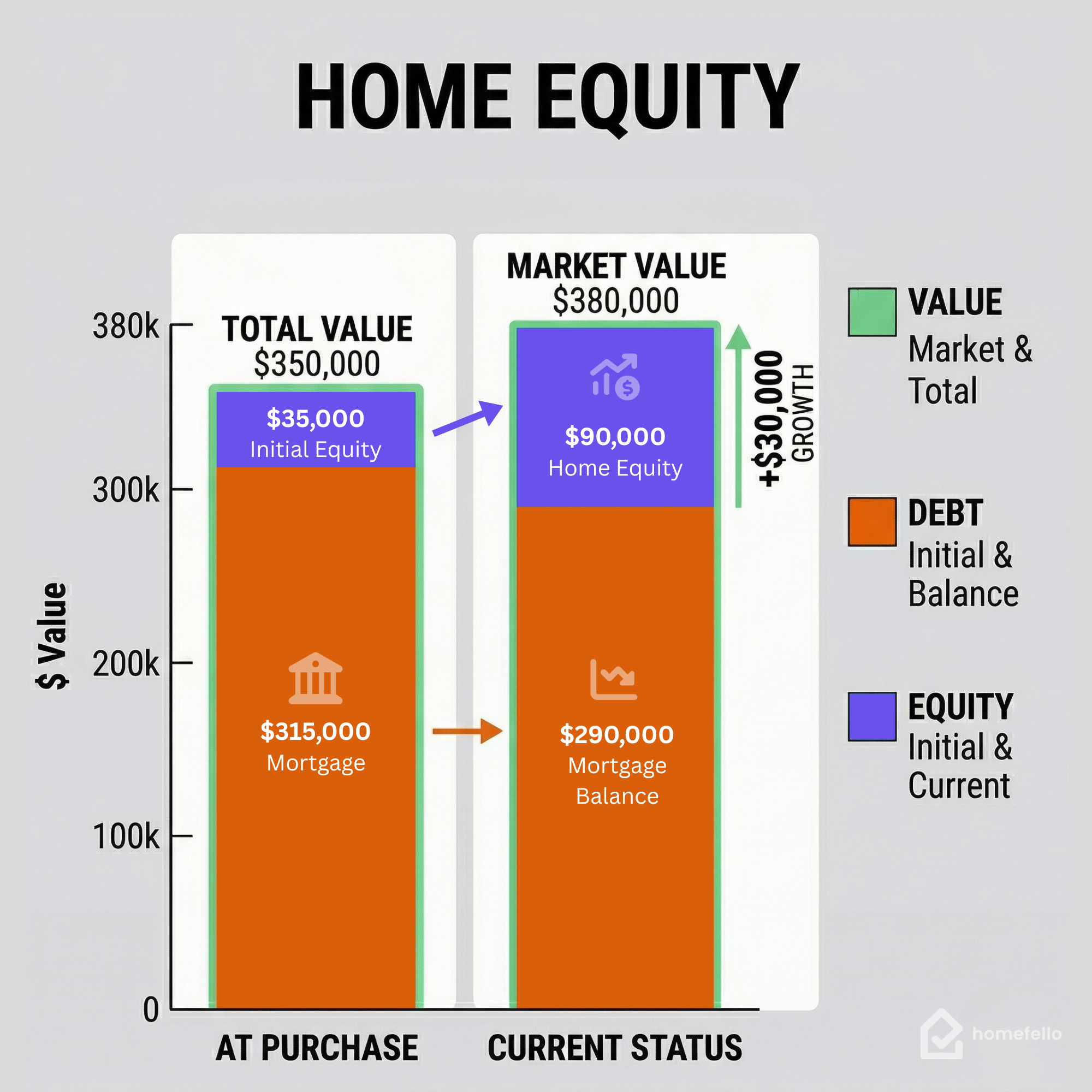
While paying down your mortgage and rising home values are the primary ways equity grows over time, homeowners can also influence equity in other ways. For example, making a larger down payment when purchasing a home immediately grants you more ownership stake. Certain home improvements may increase a home’s market value and contribute to higher equity.
How to Calculate Home Equity
Calculating your home’s equity is relatively simple. All you need to know is your home’s current market value and your remaining mortgage balance.
First, estimate the value of your home. This can come from a recent appraisal, a real estate agent’s estimate or comparable home sales in your area.
Next, find your current mortgage balance. This information is typically found in your mortgage payment portal or on your most recent loan statement.
Once you have both numbers, subtract the mortgage balance from the home’s value.
Home Equity Calculator
While this calculation provides an estimate, the precise amount of equity available for borrowing may depend on lender requirements and loan-to-value limits. Lenders may also evaluate factors like your credit profile and debt-to-income ratio when determining how much you can borrow.
How Can You Tap Into Your Home’s Equity?
Home equity can sometimes be converted into cash through borrowing, which makes it a desirable financing tool for homeowners who need funds, especially for larger purchases like home renovations. Because your home serves as collateral, lenders may allow you to access a portion of its value through specialized loan products.
Home Equity Loans
A home equity loan allows homeowners to borrow a lump sum using their home as collateral. The loan amount is based on the equity you’ve built in the property and is typically repaid in fixed monthly installments over a set term.
Because these loans usually have fixed interest rates and predictable repayment schedules, they are an attractive option for borrowers who like to know exactly what to budget each month.
Home Equity Line of Credit (HELOC)
A HELOC works more like a revolving line of credit than a traditional loan, where lenders approve borrowers for a maximum credit limit based on their available home equity.
Similar to how a credit card functions, homeowners can borrow money as needed during a draw period (which typically lasts 10 years), repay it and borrow again. After the draw period ends, the loan typically enters a repayment phase where the remaining balance must be paid back.
Cash-Out Refinance
With a cash-out refinance, homeowners replace their existing mortgage with a new, larger mortgage. The new loan pays off their original mortgage, and the borrower receives the difference between the two loans in cash.
This option allows homeowners to access equity while refinancing their mortgage, which may also change the loan term or interest rate depending on market conditions.
How Much Equity Do You Need Before Borrowing?
Most lenders require homeowners to achieve and maintain a certain amount of equity in their property before allowing them to borrow against it.
As many lenders limit borrowing to around 80% to 85% of the home’s value, homeowners typically need at least 15% to 20% equity before qualifying for an equity lending product.
Exact requirements vary by lender and loan type, and other factors like credit score and debt-to-income ratio may also influence eligibility. Homeowners often estimate their potential monthly payments using a mortgage calculator before deciding whether to borrow against their equity.
What Happens to Home Equity When You Sell?
When a homeowner sells a property, any remaining mortgage balance must be paid off from the proceeds of the sale. The remaining funds after paying off the mortgage represent the homeowner’s equity.
For example, if you sell your home for $450,000 and your remaining mortgage balance is $300,000, the difference of $150,000 represents your equity before closing costs and selling expenses are deducted.
After those costs are subtracted from the total, the remaining proceeds belong to the homeowner.
Equity vs. Loan-to-Value (LTV)
Loan-to-value ratio (LTV) is a metric lenders use to measure risk by comparing how much of a home’s value is financed by debt versus owned by the borrower. It is closely related to home equity.
The formula is:
LTV = Loan Balance ÷ Home Value
For example: if your home is worth $400,000 and you owe $300,000 on your mortgage, your LTV would be 75%.
In this scenario, the remaining 25% represents your home equity.
Lower LTV ratios generally indicate greater equity and lower risk for lenders because a larger portion of the home’s value is owned by the borrower rather than financed with debt. As a result, homeowners with higher equity levels may have more borrowing options or qualify for better loan terms.
Pros and Cons of Using Home Equity
Using home equity can provide financial flexibility, but it also carries potential risks.
Pros
- Home equity loans and HELOCs often offer lower interest rates than unsecured loans
- Borrowers may be able to access larger amounts of money compared to other types of credit
- Funds can be used for large-scale purchases like renovations, debt consolidation or major expenses
Cons
- Your home serves as collateral for the loan
- Borrowing against equity increases your total debt
- Failure to repay the loan could lead to foreclosure
FAQs About Home Equity
Home equity builds gradually as mortgage payments reduce the loan balance and as property values potentially increase. Because most mortgages follow an amortization schedule where early payments are weighted toward interest, equity tends to build more slowly in the first few years and faster later in the loan. The speed of equity growth also depends on factors like loan terms, payment schedule and local housing market conditions.
Yes. If home prices decline or if a homeowner takes on additional debt secured by the property, the amount of available equity may decrease.
In many cases, homeowners can request removal of private mortgage insurance (PMI) once they reach at least 20% equity in their home.
Many lenders require homeowners to have at least 15% to 20% equity in their property before qualifying for a home equity loan or HELOC.